About JELT
The Journal of English Language Teaching (JELT) is an international, double-blind, peer-reviewed scholarly journal published bimonthly by the English Language Teachers’ Association of India (ELTAI). Established in 1965, prior to the formation of ELTAI in 1969 and its registration in 1974, JELT has maintained uninterrupted publication for six decades.
As the flagship publication of ELTAI, the journal provides a rigorous academic platform for research and critical inquiry in English language teaching, applied linguistics, teacher education, and related areas of English studies. It publishes original research articles, theoretical discussions, pedagogical analyses, and context-responsive studies that address English language teaching and learning across diverse educational, linguistic, and sociocultural settings.
JELT follows a Diamond Open Access publishing model. The journal does not charge any submission, processing, or publication fees (APCs). All content is freely accessible online immediately upon publication, ensuring equitable dissemination of research. Articles are published under a Creative Commons licence (CC BY-NC-ND 4.0), allowing non-commercial sharing with proper attribution and no modifications. Print copies are distributed to ELTAI members as part of the Association’s academic outreach.
The journal operates under a clearly defined editorial governance structure and maintains full editorial independence. All submissions undergo a double-blind peer review process to ensure academic integrity, methodological rigour, and relevance to the journal’s scope. Manuscripts are accepted on a rolling basis and must be submitted through the journal’s online submission system.
JELT publishes six issues annually (January–February, March–April, May–June, July–August, September–October, and November–December) and adheres to recognised standards of publication ethics and transparency in scholarly communication.
Current Issue
Vol. 68 No. 4 (2026): July-August
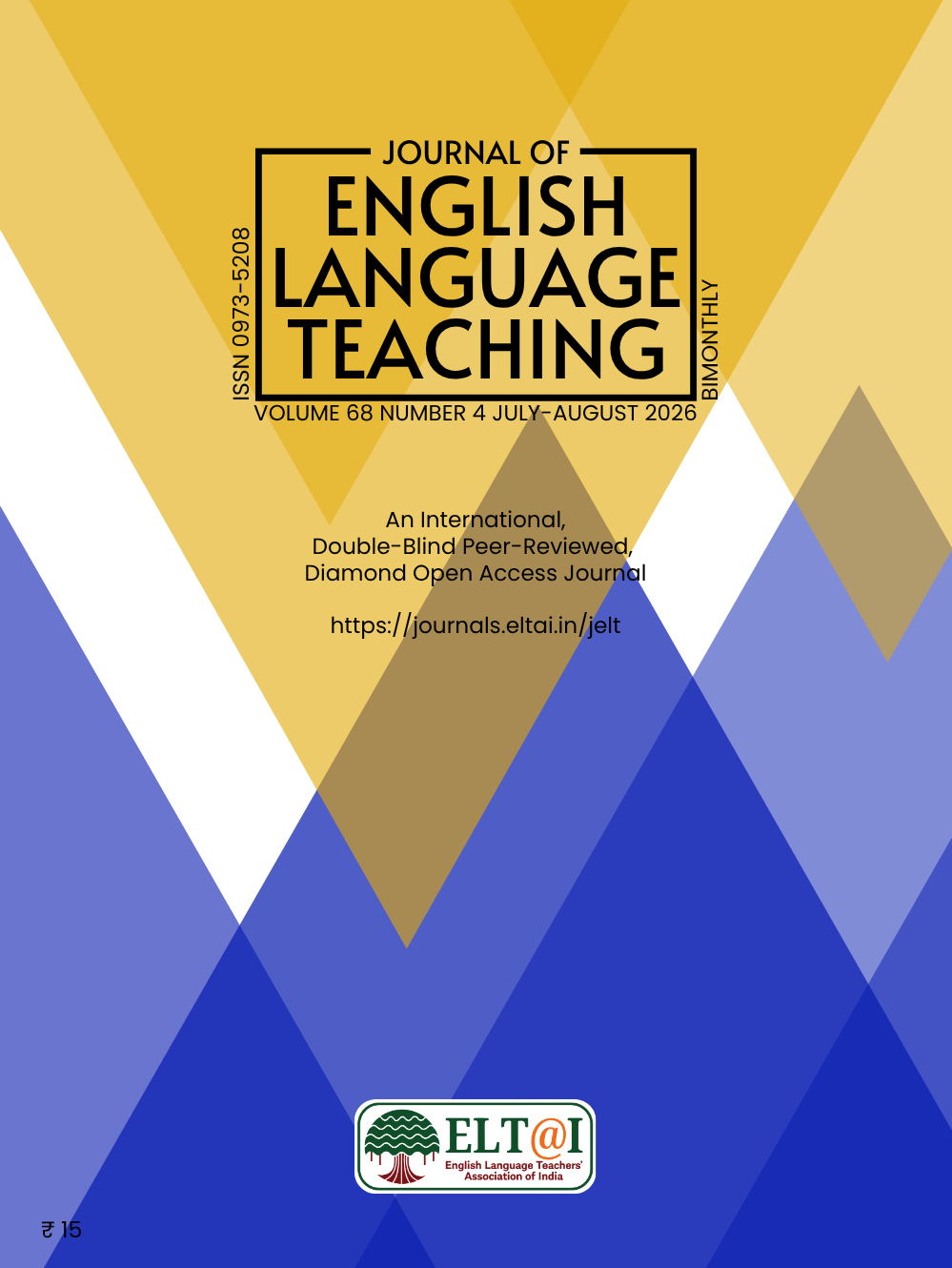
The July–August 2026 issue of the Journal of English Language Teaching (Vol. 68, No. 4) presents a diverse collection of research and scholarly perspectives on contemporary English language education. Its contributions examine English-medium instruction and students’ academic experiences, L1 influence on Kurdish learners’ interlanguage, intercultural communication strategies among Thai university students, and approaches to reducing speaking anxiety among first-generation ESL learners. The issue also explores forensic linguistics as a pedagogical resource, teacher self-perception and professional performance, teacher identity in digital learning spaces, and the evolving paradigms of World Englishes. A book review on translanguaging further extends the issue’s emphasis on multilingual and inclusive pedagogies.
Published:
26-08-2026